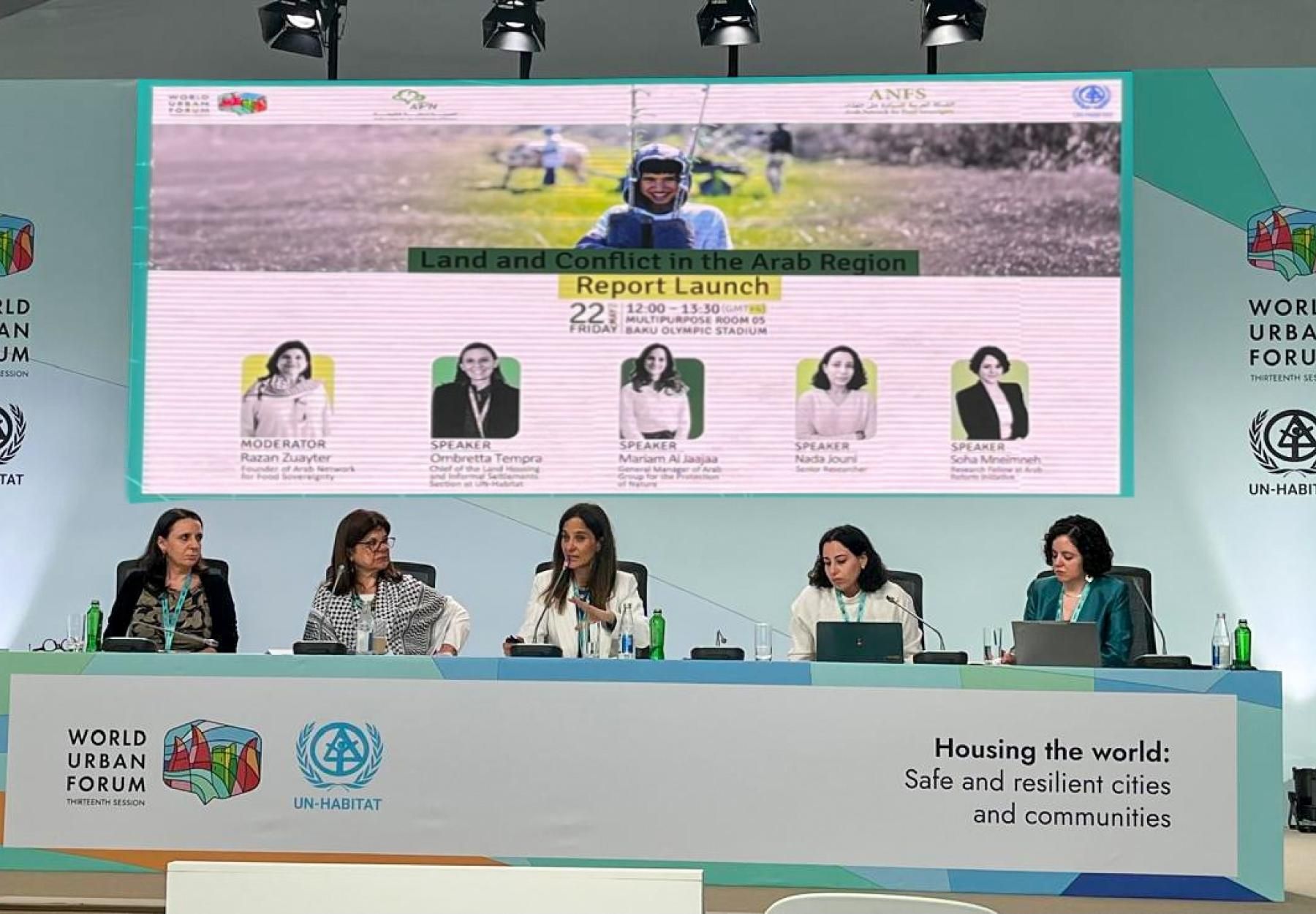
Amid escalating land-related conflicts and their growing impact on the rights of local communities, food security, and social stability across the Arab region, APN launched its report, "Land and Conflict in the Arab Region". The report provides an in-depth regional analysis of the complex relationship between land issues and conflict, while offering recommendations grounded in rights-based approaches, justice, and sound land governance. The report was launched during the 13th session of the World Urban Forum, held in Baku, Azerbaijan, which brought together nearly 20,000 participants. The launch took place as part of a specialised event that convened experts, researchers, and representatives of international and regional organisations.
APN organised a side event titled “Land and Conflict in the Arab Region: Report Launch” on Friday, 22 May 2026. Speakers include Razan Zuayter (Arab Network for Food Sovereignty and People’s Coalition on Food Sovereignty), Mariam Al Jaajaa (APN), Ombretta Tempra (UN-Habitat), Soha Mneimneh (Arab Reform Initiative), and senior researcher Nada Jouni.
The report is a comprehensive regional study examining the complex relationship between land and conflict across the Arab region. The report combines a main analytical study with twelve in-depth case studies from Algeria, Morocco, Lebanon, Egypt, Libya, Palestine, Syria, Tunisia, and Yemen, documented by regional and national experts and practitioners.
The event presented key findings and lessons from selected case studies, while facilitating dialogue on rights-based approaches to land governance, land use management, housing recovery, and conflict prevention and response in conflict-affected settings. As one of the few sessions at WUF13 dedicated to this issue, the discussion aimed to contribute concrete recommendations to the outcomes and declaration emerging from the Forum.
During the session, Mariam Al Jaajaa explained that one of the primary motivations behind undertaking the project was the severe shortage of specialized Arab studies on land and conflict. This gap has led to an overreliance on external research, which has often produced inaccurate diagnoses of the nature and root causes of conflicts. She added that this knowledge deficit can result in ineffective conflict-resolution mechanisms and may, in some cases, even exacerbate conflicts rather than mitigate them.
Al Jaajaa further noted that analysing land-related conflicts reveals deeper structural and historical drivers, including the introduction of capitalist modes of production, colonialism and settler colonialism, the persistence of neo-colonial practices, and other internal and external factors that have accumulated over time and shaped these conflicts. She emphasised that these dimensions are frequently overlooked in mainstream literature.
For her part, Razan Zuayter stressed that any genuine approach to addressing land-related conflict in Palestine must begin with the just, comprehensive, and lasting dismantling of settler colonialism through a Palestinian-led, decolonial one-state solution. Such an approach, she argued, must guarantee full equality of rights throughout historic Palestine, equitable land redistribution, reparations, and the inalienable right of return. She also underscored the need for consistent adherence to international legal obligations without double standards, rejecting the politicisation of international law and ensuring accountability for those responsible for genocide, starvation, ecocide, and settler colonialism.
Ombretta Tempra highlighted that the report sheds light on the long-term interactions and cumulative processes that gradually weaken communities' capacity to manage conflicts and mitigate their impacts until existing balances become unsustainable, creating conditions for escalating violence. She emphasised that violence ultimately represents the final stage in the erosion of people's ability to coexist and manage resources fairly and sustainably.
Researcher Nada Jouni presented Lebanon as a case study illustrating the intersection of land, conflict, and environmental destruction. She noted that the ongoing war demonstrates how unresolved conflicts perpetuate cycles of environmental and social devastation. She explained that southern Lebanon is once again witnessing attacks on agricultural land, civilian infrastructure, and livelihoods, while communities already affected by previous conflicts are facing renewed waves of displacement and loss.
Jouni warned that the absence of accountability and effective protection for civilian infrastructure enables the recurrence of the same tragedies. She also pointed to what she described as attempts to impose a buffer zone in southern Lebanon as a means of forcing residents off their land and engineering demographic change.
In the same context, Soha Mneimneh called for a critical reassessment of several globally dominant environmental concepts and narratives. She cautioned against the use of environmental rhetoric to justify practices of greenwashing and land appropriation, including the use of certain afforestation projects as tools for territorial control and the restructuring of land-use patterns.
She concluded by emphasising that international conventions guarantee the rights to housing and land. However, the limited effectiveness of the international protection system in certain contexts underscores the need for international legal and political reforms that strengthen global justice, restore confidence in multilateral institutions, and ensure the protection of the fundamental rights of communities affected by conflict.
Key recommendations emerging from the report emphasise the need for fit-for-purpose land administration systems that secure land tenure rights for all, recognition and protection of collective and communal land rights, and land reforms that address historical injustices and inequalities. The recommendations also call for strengthening transitional justice and dispute resolution mechanisms, protecting productive rural land and agricultural infrastructure in conflict settings, supporting participatory land and conflict assessments, and enhancing the role of civil society and local communities in peacebuilding and land governance processes.
The recommendations further stress that ending settler-colonialism, occupation, foreign military interventions, and forcible transfer must remain a priority for states, as well as international and national humanitarian and development actors, particularly the UN and other multilateral bodies with a key role in promoting peace, accountability, and justice.