APN | Zoom
11 September 2025
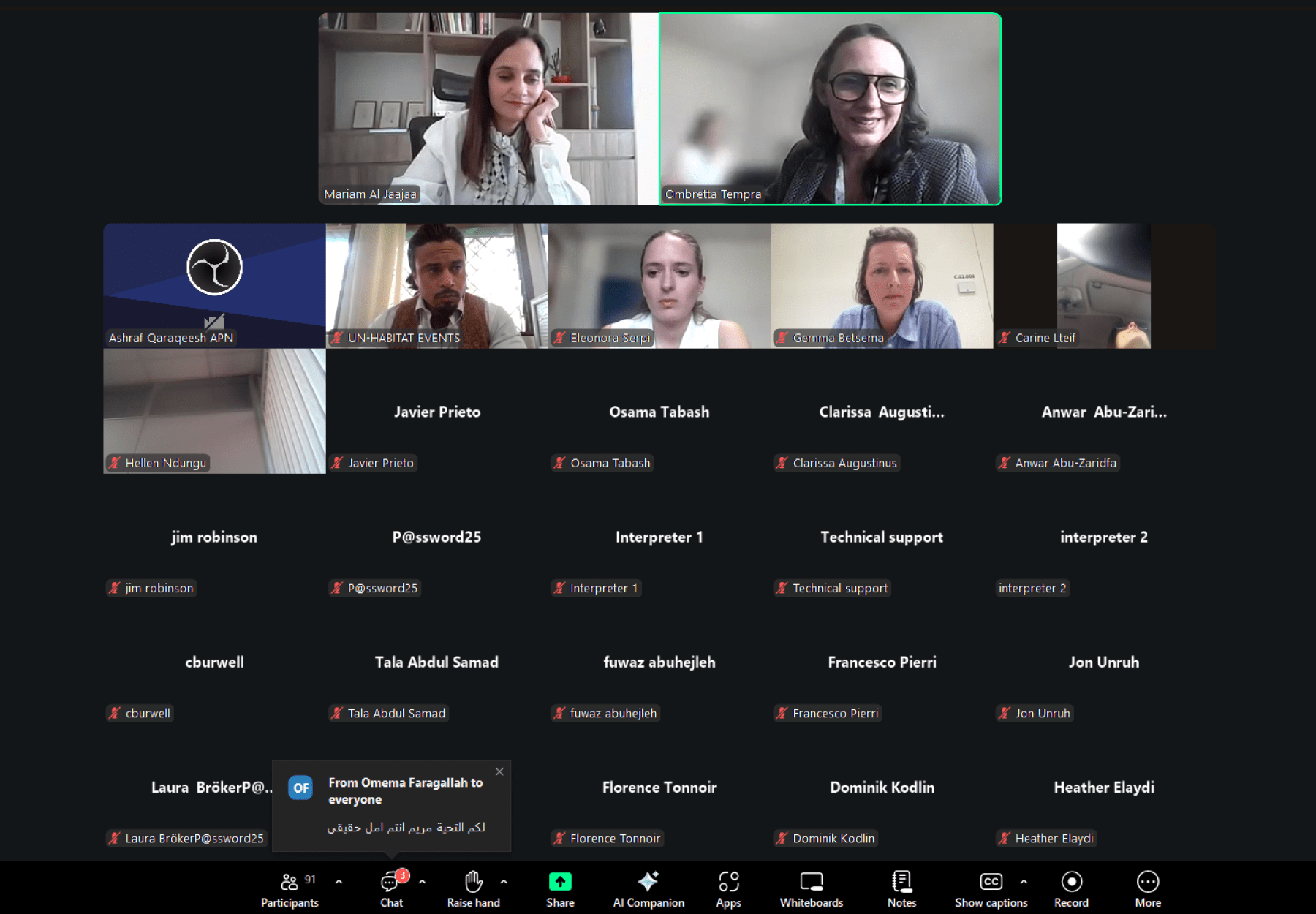
In a special webinar organized by UN-Habitat titled "Land and Conflict in the Arab Region", in collaboration with representatives of Dutch embassies, APN General Manager Mariam Al Jaajaa emphasised the importance of scaling-up targeted studies on land issues by research institutions in the Arab region, given that land, and control over land more specifically, is a root cause of many conflicts. She stressed that the reliance on foreign scientific and academic outputs exposes analyses to linguistic challenges and misdiagnoses. This can lead to poorly-crafted interventions that may exacerbate disputes rather than resolve them. She noted that APN is currently preparing a study on this matter.
In her presentation, Al Jaajaa highlighted the need to correct the false ethnic and religious narratives used to explain conflicts, stating that many of these disputes are fundamentally driven by modern capitalist policies, colonialism and neo-colonialism, as well as weak land governance structures.
Moreover, she explained that patterns of land-related conflict in the Arab world assume multiple forms. However, a constant feature of such conflicts is the injection of capital into traditional production systems, which has caused major ruptures in land tenure, access for small-scale farmers, and relations between herders and farmers. This has been particularly evident in areas of Morocco, Algeria, and Tunisia, where the commodification of land has led to surging market prices and increased speculation.
Critically, Al Jaajaa called for actors to confront colonialism, settler colonialism, and occupation as key root causes, citing Palestine as the most prominent example, alongside Lebanon and Iraq. She further discussed conflicts stemming from inequitable land distribution and agricultural investment, referring to western Libya as a case in point.
Al Jaajaa affirmed that the relationship between land and conflict is shaped by both internal and external factors, including proxy wars, the perpetuation of occupation with financial, diplomatic, and military support, the failure of the international legal system, and the absence of effective national reconciliation platforms.
Spotlighting Palestine, she stated that Palestinians have lost 77% of their historic land in 1948, noting that the occupation now seeks to control 96.2% of that land through the annexation of large areas in the West Bank and Gaza Strip, in addition to full control over Palestinian water resources.
In conclusion, Al Jaajaa called on European countries to sever financial, academic, and logistical ties with the Israeli occupation, and welcomed the concrete measures taken by the Netherlands, such as the resignation of several ministers, as well as judicial and diplomatic decisions to halt the export of F-35 fighter jet parts to the Israeli occupation and impose restrictions on the export of military and dual-use items.
However, she noted that the Netherlands still maintains economic and academic ties with the occupation, pointing out that the largest Dutch pension funds invest hundreds of millions in weapons companies that supply the occupation. Additionally, major universities are involved in European projects with Israeli institutions, some of which are connected to the military industry. Meanwhile, the Port of Rotterdam continues to play a central role in the F-35 parts supply chain.
She also urged support for advocacy and lobbying campaigns, including the campaign to enter seeds into Gaza.
Listen to the speech here.