APN | Zoom
16 December 2025
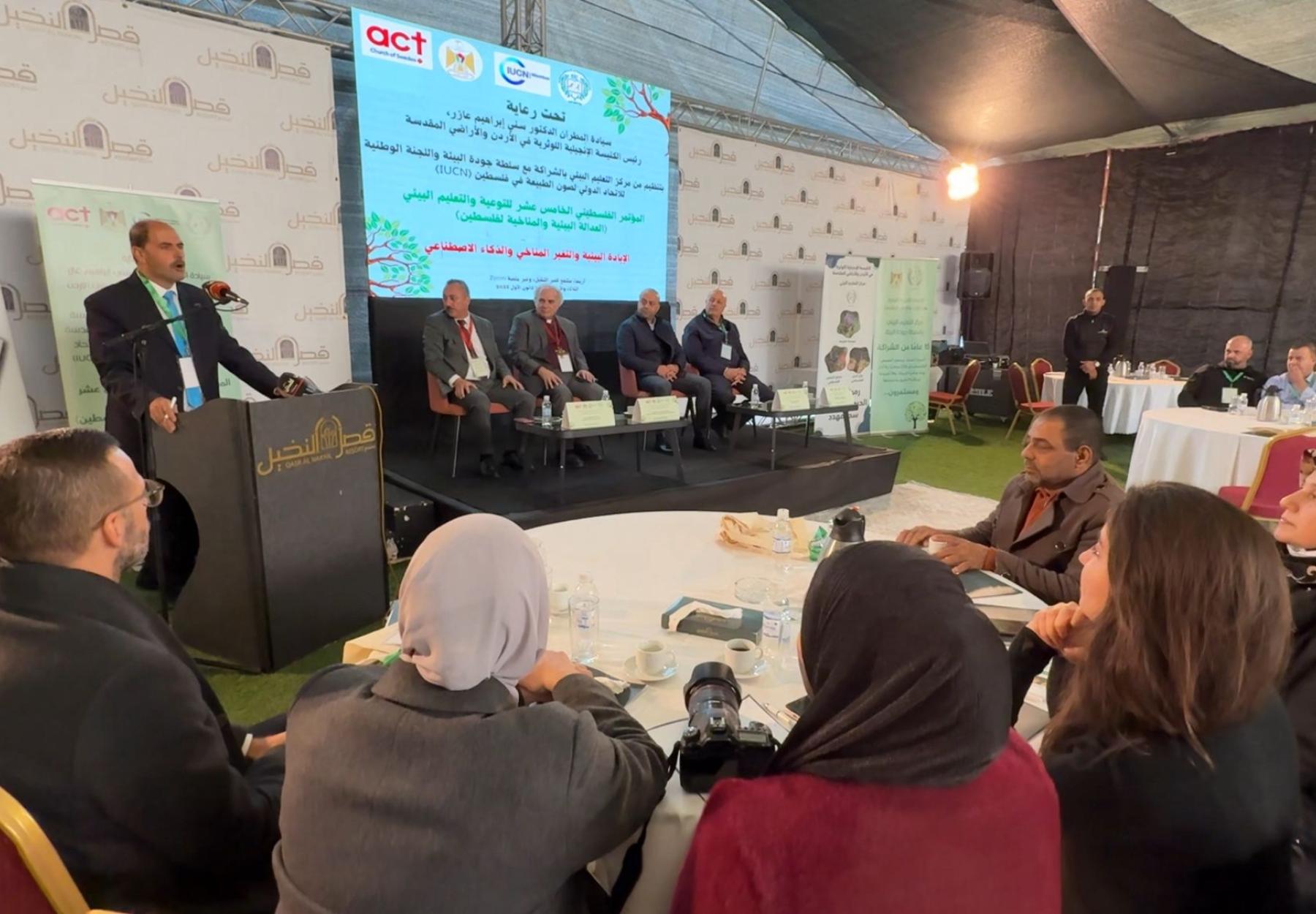
APN took part in the 15th Palestinian Environmental Awareness and Education Conference, organised by the Environmental Education Center of the Evangelical Lutheran Church in Jordan and the Holy Land, in partnership with the National Committee of the International Union for Conservation of Nature (IUCN) in Palestine and the Palestinian Environment Quality Authority. APN Mobilisation and Awareness Officer Ghaid Harairi presented a paper titled “The Forgotten Face of the Climate Crisis and Recovery Plans”, which explored the often-overlooked dimensions of climate change, particularly in developing countries facing conflict and occupation.
The paper drew attention to the dual threats of climate change and climate injustice, highlighting how developing countries shoulder disproportionate burdens despite their minimal contribution to global emissions. It also examined the role of occupation in intensifying the effects of climate change across Jordan, Palestine, Lebanon, and the Gaza Strip, through the systematic destruction of natural resources and the erosion of food sovereignty.
APN’s research outlined a series of key recommendations, including adopting a human rights-based approach to climate action, addressing the root causes of climate vulnerability rather than only responding to its consequences, supporting local and sustainable agricultural systems and reforestation; together, strengthening communities' steadfastness to remain rooted in their land. It also emphasised the need for tailored strategies to adapt to and mitigate climate impacts in regions afflicted by war and occupation.
In this context, Harairi underscored the urgent need to bolster local initiatives amid limited international response. She highlighted APN’s work in enhancing food sovereignty and supporting communities in adapting to and mitigating climate impacts.
Harairi also noted that APN has successfully planted over three million trees in the region, absorbing more than 66 million kilograms of carbon emissions, helping to reduce potential economic and social losses from climate change, and strengthening the capacity of local communities to confront its escalating consequences.